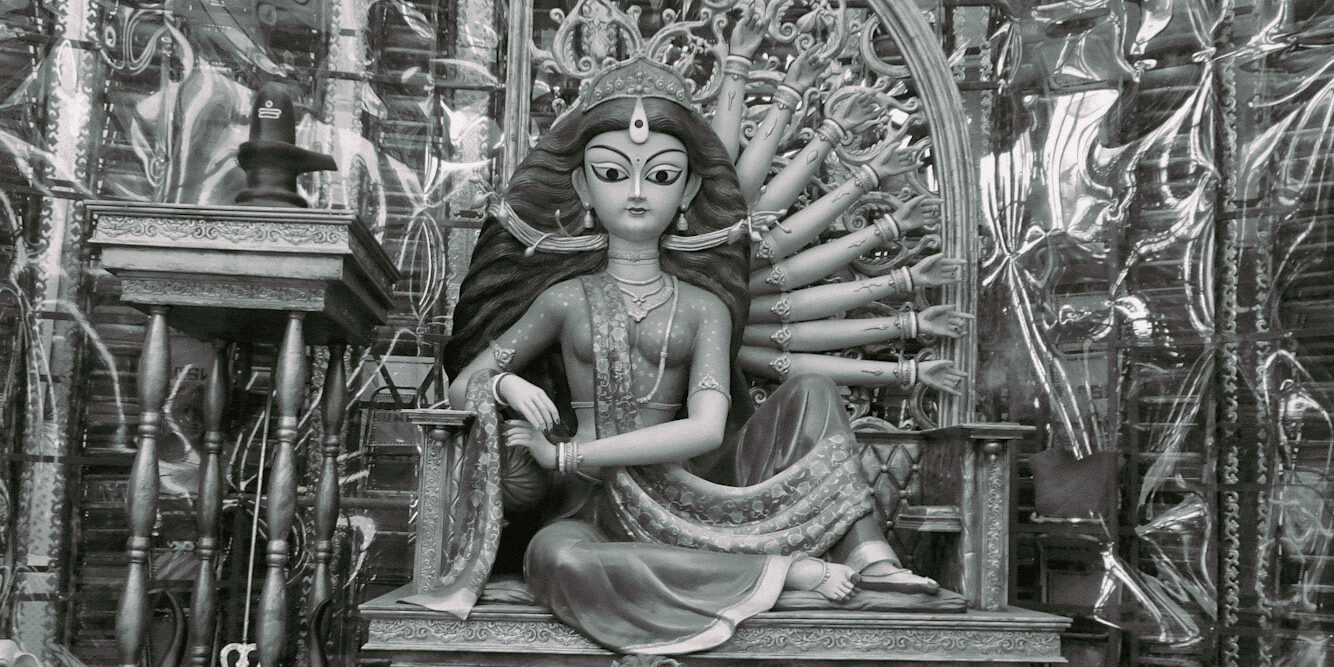
The Devi Bhagavata Purana—sometimes referred to as the Devi Bhagavatam, Bhagavata Purana, or Srimad Devi Bhagavatam—is a foundational Sanskrit text, recognized as one of the eighteen Mahapuranas in Hindu literature. For practitioners devoted to Devi (the Goddess), this scripture holds particular significance, effectively serving as a central sacred text.
The Purana is extensive, spanning twelve cantos and totalling 318 chapters. Alongside the Devi Mahatmya, it stands as a core text for Shaktism, the tradition within Hinduism that venerates Devi or Shakti as the ultimate creative and sustaining force behind the universe. Here, the Goddess is not simply a figure among many; she is presented as the primary divinity—originator, preserver, and destroyer—who also bestows spiritual liberation. While many Puranas acknowledge the Goddess, the Devi Bhagavata Purana places her at the narrative’s center. Philosophically, the text blends Advaita Vedanta-style monism with deep devotional worship of Shakti, merging nondual metaphysics with a strong emphasis on personal devotion. The name Srimad Devi Bhagavata combines terms meaning “devotees of the blessed Devi.” The word ‘Srimad’ (or ‘Srimat’) conveys meanings such as radiant, splendid, or holy, serving as an honorific. The term ‘Sri’ is often associated with prosperity and is a title for goddesses such as Lakshmi and Tripura Sundari, who are venerated as supreme forms of the divine feminine. Devi Bhagavata Purana is a critical resource for understanding the theological and philosophical foundations of goddess worship in Hinduism, offering a comprehensive vision of the Goddess as the ultimate reality and source of all existence.
In Shakta philosophy, the soul is regarded as fundamentally united with the Divine, with special emphasis on the feminine principle—Shakti—as the ultimate reality. Shakti, conceptualized as the Divine Mother or Goddess Power, serves as the intercessor who grants this nondual liberation (moksha) to her devotees. Moksha, here, refers to total identification with the transcendental Divine, accomplished through the awakening and ascent of kundalini shakti—the individualized form of divine energy—along the sushumna channel to the crown of the head, culminating in union with Shiva. The spiritual practices found in Shaktism, also referred to as tantra or tantrism, are in many aspects similar to those in Shaivism. However, Shaktism places greater emphasis on divine power rather than on pure Being or Consciousness. Shakta sadhana includes visualization exercises, ritualistic use of mantras, symbolic hand gestures (mudras), and the employment of sacred geometric diagrams (yantras). The human body is understood as a temple of the Divine, and as such, a variety of methods are prescribed for its purification and transformation. Philosophically, Shaktism’s yogic worldview encompasses the reconciliation of opposites: male and female, absolute and relative, pleasure and pain, cause and effect, mind and body. The tradition’s shamanistic aspects may involve practices such as magic, trance mediumship, firewalking, and animal sacrifice, generally aimed at healing, fertility, prophecy, or empowerment. In certain “left-hand” tantric circles, antinomianism becomes evident, seeking to transcend established moral codes. Within Shaktism, the state of jivanmukti—spiritual liberation while living—is referred to as kulachara, or “the divine way of life,” attained through spiritual discipline (sadhana) and divine grace. The liberated individual, known as a kaula-siddha, perceives all dualities as equal; such a person may interact with the world, even assuming roles such as kingship, yet remains unbound by the cycle of rebirth, as their actions no longer accrue karmic consequences. The Goddess, Devi, is believed to grant both liberation (mukti) and worldly enjoyment (bhakti). As Dr. Sarvepalli Radhakrishnan observed, the individual soul, under the influence of maya, perceives itself as an independent agent until ultimate release is achieved. Knowledge of Shakti is viewed as the path to salvation—a dissolution into the blissful radiance of the Supreme.