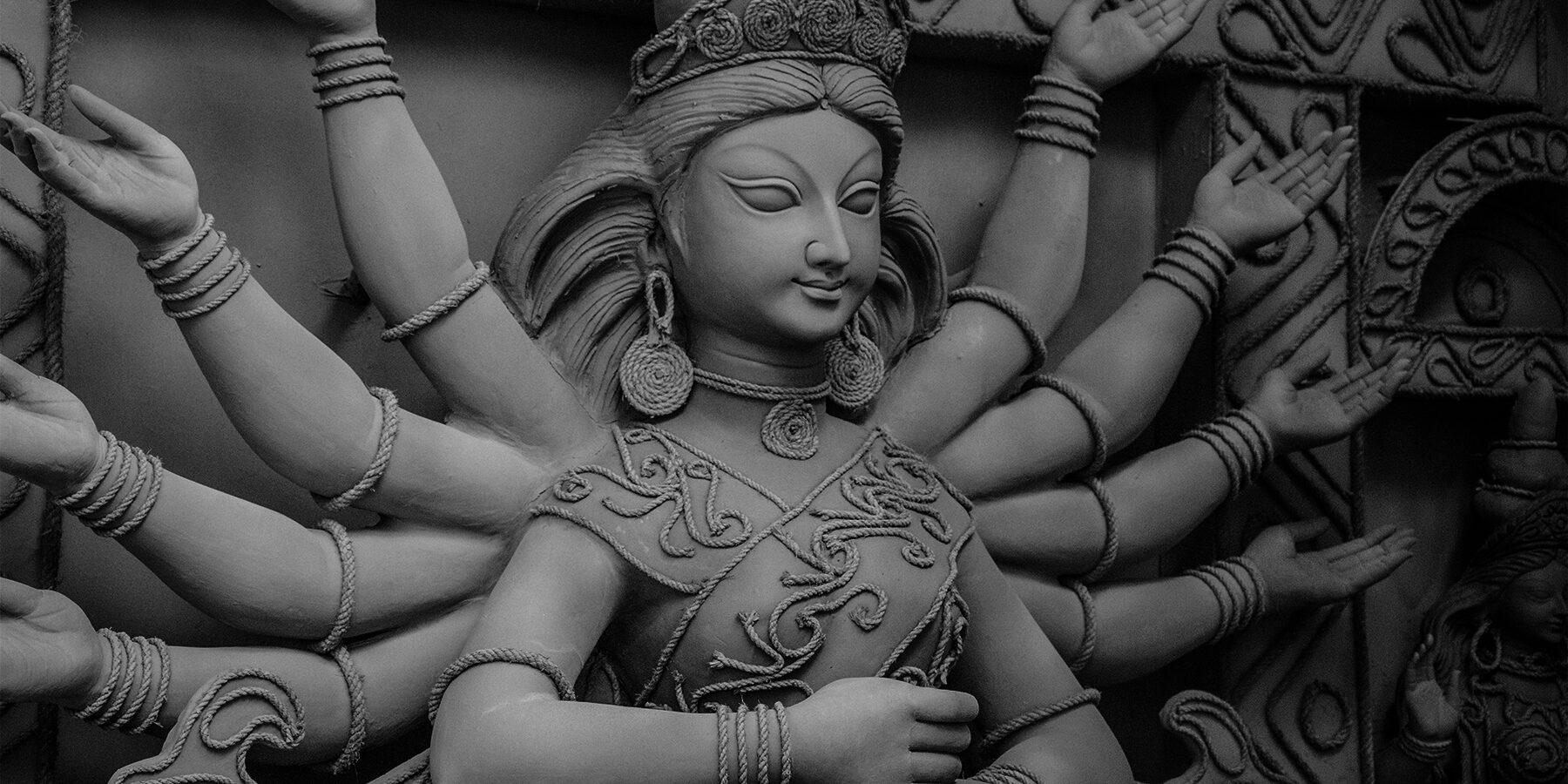
When the faint fragrance of shiuli blossoms drifts into Bengal’s early autumn air, and the dark sky turns indigo before sunrise, radios across the state begin to hum with a voice that has become eternal. It is Birendra Krishna Bhadra’s recitation of the Mahishasura Mardini, broadcast on All India Radio (AIR). This moment is Mahalaya — the beginning of Durga Puja, the invocation of the Goddess, the herald of autumn.
For Bengalis, Mahalaya is not just a date on the lunar calendar — it is a collective memory, a spiritual call, and a cultural anchor that unites generations.
1. What is Mahalaya?
Mahalaya is observed on the last day of Pitru Paksha (the fortnight of ancestors), just before the advent of Devi Paksha (the fortnight of the Goddess).
-
Religious significance: It is believed that on Mahalaya, the Goddess Durga begins her journey from Kailash to her maternal home on earth.
-
Pitru Tarpan: Traditionally, people perform rituals on riverbanks to honor ancestors, offering prayers, water, and food.
-
Cultural significance: In Bengal, Mahalaya has become synonymous with the iconic AIR broadcast that awakens not only the Goddess but also the entire community’s festive spirit.
It is the dawn of Durga Puja, the signal that Bengal’s greatest festival is about to begin.
2. Mythological Background
Mahalaya draws on multiple strands of Hindu mythology:
-
The Devi Mahatmya (Markandeya Purana) narrates the story of Durga’s creation and her battle with Mahishasura. The gods, powerless against the buffalo demon, pooled their energies to form a radiant goddess, armed with their weapons. Her battle lasted nine nights, culminating in Mahishasura’s defeat.
-
Ramayana connection: Another legend says that Rama performed the first Akal Bodhan (untimely invocation) of Durga during autumn, before his battle with Ravana. This links Mahalaya with Rama’s prayers and the start of Devi worship in sharat kaal (autumn).
-
Uma’s homecoming: Folk imagination adds tenderness — Durga is Uma, daughter of the Himalayas, returning home each autumn. Mahalaya is the morning her arrival is first anticipated.
3. Mahalaya Rituals: Pitru Paksha Ends, Devi Paksha Begins
Mahalaya is also about honoring the dead.
-
Tarpan: At dawn, devotees gather at riverbanks like the Ganges in Kolkata, Hooghly, or Damodar, offering water, sesame seeds, and prayers to ancestors. Priests guide families in rituals to ensure the blessings of forefathers.
-
Transition of energies: With Pitru Paksha ending, it is believed the ancestors return satisfied, and the cosmic space opens for the Goddess’s arrival.
Thus Mahalaya is both farewell and welcome — a farewell to ancestral spirits, a welcome to Durga.
4. All India Radio and the Making of a Tradition
The story of Mahalaya is inseparable from the voice that made it unforgettable.
The Birth of “Mahishasura Mardini” Program
-
In 1931, All India Radio Calcutta (Akashvani) began broadcasting a special program in the pre-dawn hours of Mahalaya.
-
The script was composed by Bani Kumar (Banikantha Mukhopadhyay).
-
The music was directed by Pankaj Kumar Mullick, one of Bengal’s greatest music directors.
-
And the voice — unforgettable, deep, resonant — was that of Birendra Krishna Bhadra, reciting Sanskrit shlokas and narrating the Devi Mahatmya in a style that made myth come alive.
The program was titled “Mahishasura Mardini”, a two-hour audio montage of chants, narration, devotional songs, and music.
Why it Became Eternal
-
The broadcast began at 4:00 AM — the Brahma Muhurta, an auspicious time for worship.
-
For decades, families would rise before dawn, sit around the radio, and listen together.
-
Bhadra’s voice, combined with songs like “Jaago Tumi Jaago” and “Bajlo Tomar Alor Benu”, etched itself into Bengal’s consciousness.
5. The 1976 Experiment — and the Backlash
In 1976, AIR tried to replace Birendra Krishna Bhadra’s voice with Uttam Kumar, Bengal’s beloved matinee idol.
-
Though Uttam Kumar was a legend in cinema, listeners found his delivery too polished, too modern.
-
People protested, demanding the return of Bhadra’s version.
-
AIR quickly reverted, and since then, Bhadra’s recording has remained the eternal Mahalaya broadcast.
This incident proved that Mahalaya was not just a radio program — it was a ritual, a memory, a collective identity.
6. Anatomy of the Broadcast
The program “Mahishasura Mardini” blends scripture, music, and performance art:
-
Narration: Birendra Krishna Bhadra recites verses from the Chandi and other scriptures, invoking Durga in Sanskrit.
-
Songs: Sung by legendary vocalists — Hemanta Mukhopadhyay, Sandhya Mukhopadhyay, Manabendra Mukhopadhyay, Arati Mukhopadhyay, Dwijen Mukhopadhyay.
-
Orchestration: Classical ragas, devotional tunes, and Pankaj Mullick’s arrangements give the program a timeless quality.
Famous pieces include:
-
“Bajlo Tomar Alor Benu” (Your flute of light has sounded).
-
“Jaago Tumi Jaago” (Awaken, O Mother).
-
“Subhra Jyotsna Pulakita” (A hymn of dawn).
Each section marks Durga’s journey, her battle, her triumph.
7. Mahalaya as Collective Memory
For Bengalis, Mahalaya is:
-
Nostalgia: Waking up before dawn, radio crackling, family gathered under dim lights.
-
Emotion: The goosebumps when Bhadra chants “Ya Devi Sarvabhuteshu…”
-
Seasonal marker: Just as Christmas carols mark December, Mahalaya marks the beginning of autumn’s festive season.
-
Generational link: Grandparents, parents, children — all sharing the same broadcast across decades.
Mahalaya is where myth meets memory, and media becomes tradition.
8. Unknown & Fascinating Facts
-
First Broadcast: Began in 1931, nearly 95 years ago.
-
Recording: The Bhadra version most people hear today was recorded in 1966.
-
Global Reach: Today, Mahalaya is streamed on YouTube, FM radio, apps, and still retains millions of listeners worldwide.
-
Duration: The program originally ran for nearly two hours, now sometimes shortened for modern broadcasts.
-
Other Performers: While Bhadra is iconic, the program also featured singers like Supriti Ghosh, Shyamal Mitra, and Pratima Bandopadhyay.
9. Mahalaya Beyond AIR
-
Television: In the 1980s, Doordarshan began telecasting Mahishasura Mardini dance-dramas, often starring leading actors as gods and goddesses.
-
Digital era: Today, Mahalaya is available on Spotify, YouTube, and AIR apps. Yet many still tune into shortwave radio at dawn — to preserve the ritual.
-
Global diaspora: Bengalis abroad often stream the broadcast live to feel connected to Bengal’s heartbeat.
10. The Emotional Arc of the Festival
Mahalaya is not the Puja itself — it is the threshold. It is the moment anticipation begins, the first beat of the dhaak sounds in the mind, the first shiuli blossoms scatter on dewy grass.
From Mahalaya to Dashami, every day carries this emotional arc:
-
Shashthi: Bodhon (invocation).
-
Saptami: Nabapatrika.
-
Ashtami: Anjali and Kumari Puja.
-
Navami: Feasting and revelry.
-
Dashami: Sindoor Khela and farewell.
But it is Mahalaya morning that sets the tone — the Goddess is coming.
11. Mahalaya as Cultural Heritage
UNESCO has already recognized Kolkata’s Durga Puja as Intangible Cultural Heritage. Many argue that Mahalaya’s AIR broadcast deserves similar acknowledgment, as it represents:
-
The blending of ancient scripture with modern media.
-
An unbroken ritual of nearly a century.
-
A unique cultural marker for Bengalis worldwide.
12. Conclusion: The Eternal Dawn
Mahalaya is more than just a date or a broadcast. It is:
-
A ritual that unites faith and family.
-
A cultural landmark that merges mythology, music, and memory.
-
The moment that awakens Bengal’s greatest festival.
When Birendra Krishna Bhadra’s voice chants, “Ya Devi Sarvabhuteshu…”, Bengalis know the year has turned, the Goddess is on her way, and the festival of festivals has begun.
Mahalaya is not simply remembered — it is felt, again and again, each autumn dawn.
The Artists of Mahalaya: Voices, Music, and Memory
Birendra Krishna Bhadra – The Eternal Voice
-
Role: Narrator of Mahishasura Mardini (recitations of Sanskrit shlokas and Puranic verses).
-
Style: His deep, resonant, almost hypnotic delivery made scripture come alive.
-
Legacy: Though others attempted (notably Uttam Kumar in 1976), Bhadra’s version remains iconic. For most Bengalis, Mahalaya is synonymous with his voice.
-
Notable Chant: “Ya Devi Sarvabhuteshu Shakti Rupena Samsthita…” still sends goosebumps.
The Visionaries Behind the Program
-
Bani Kumar (Banikantha Mukhopadhyay) – Scriptwriter, dramatist, and lyricist. He wrote the Bengali verses and shaped the program into a narrative journey.
-
Pankaj Kumar Mullick – Legendary composer and music director. He blended classical ragas, devotional tunes, and orchestration to create the perfect atmosphere for dawn.
-
Sudhanshu Bhattacharya – AIR producer, credited with conceptualizing and launching the program in 1931.
Together, they created a two-hour audio montage — narration, hymns, devotional songs, and orchestral interludes.
The Singers of Mahalaya
Over the decades, some of Bengal’s greatest singers lent their voices to the program.
Hemanta Mukhopadhyay (Hemant Kumar)
-
The voice of timeless bhajans like “Jaago Tumi Jaago”.
-
His rich baritone gave devotional songs both gravitas and sweetness.
Sandhya Mukhopadhyay
-
Her songs in Mahalaya broadcasts are soft, devotional, and lyrical.
-
Famous for renditions of Agamani songs (welcoming the Mother).
Arati Mukhopadhyay
-
Known for bhakti sangeet, added warmth and emotion to the program.
Manabendra Mukhopadhyay
-
His classical training brought depth to hymns, especially in the Ushakale (dawn) portions.
Dwijen Mukhopadhyay
-
Renowned for his agomoni gaan (welcome songs), part of the AIR Mahalaya tradition.
Supriti Ghosh
-
Famous for devotional tracks in the program, including “Bajlo Tomar Alor Benu.”
Shyamal Mitra
-
His smooth voice carried some of the later Mahalaya songs, blending modern melody with devotional tone.
Pratima Bandopadhyay
-
Contributed several soulful songs in the program’s mid-years.
Instrumentalists and Orchestration
-
Classical Ragini Base: The music often begins in ragas like Bhatiyali, Bhairavi, Malkosh, evoking both dawn and devotion.
-
Use of Dhak & Tabla: Traditional instruments infused the recitation with the festival’s pulse.
-
Pankaj Mullick’s genius: Blending Indian classical with orchestral arrangements made the program both devotional and cinematic.
The 1976 Experiment — Uttam Kumar
-
In 1976, AIR replaced Bhadra’s narration with Uttam Kumar, Bengal’s matinee idol.
-
Despite his fame, listeners felt the performance lacked the gravitas of Bhadra’s voice.
-
The backlash was so strong that AIR had to reinstate the original Bhadra recording.
-
This cemented the immortality of Bhadra’s Mahalaya.
Why These Artists Endure
-
They created a collective soundscape — part scripture, part music, part storytelling.
-
Each artist brought individuality but stayed within the devotional mood.
-
The program transcended time: even today, in an era of YouTube and Spotify, families still wake at 4 AM to hear the same voices.
Famous Tracks from Mahalaya
-
“Bajlo Tomar Alor Benu” – welcoming the Mother.
-
“Jaago Tumi Jaago” – invocation to awaken the Goddess.
-
“Subhra Jyotsna Pulakita” – describing dawn and cosmic awakening.
-
“Jago Durga” – battle-call hymns.
Each is etched in Bengal’s collective memory, carried by these legendary voices.
The Legacy Today
-
Mahalaya continues to be broadcast every year on AIR at 4 AM.
-
Digitally available on YouTube, apps, and music platforms.
-
Younger artists sometimes reinterpret Mahalaya songs, but the classic version remains the ritual.
Mahalaya lives on because of Birendra Krishna Bhadra’s narration, Pankaj Mullick’s compositions, Bani Kumar’s script, and the voices of Hemanta, Sandhya, Dwijen, Arati, Manabendra, and others.
Together, they created not just a radio program but a cultural ritual that marks the start of Bengal’s greatest festival.
Image Courtesy : Sayan Biswas (Please do not use without permission)