1. Devi as Primordial Power
The text opens by establishing Nirguna Bhagavati—the formless, transcendent goddess—as the foundational reality from which all existence emerges. Identified variously as Adi Parashakti or Brahman, she is posited as both the origin and sustaining principle of the cosmos. All creative, preservative, and dissolving forces in the universe ultimately derive their efficacy from her, with major deities such as Brahma, Vishnu, and Shiva empowered only through her Saktis.
2. The Manifestation of the Three Cosmic Saktis
At the outset of creation, Devi manifests as three principal energies, collectively termed Trishakti:
– Sattvik Shakti (associated with Saraswati/Mahasaraswati), representing wisdom and creative power.
– Rajasi Shakti (manifest as Mahalakshmi), embodying activity, sustenance, and abundance.
– Tamasi Shakti (embodied by Mahakali or Parvati), signifying transformation and the dissolution necessary for renewal.
These Saktis are not merely abstract metaphysical forces but are personified as goddesses, each acting as consort and empowering principle to Brahma, Vishnu, and Shiva. Thus, every significant act attributed to these deities—creation, sustenance, or dissolution—is ultimately enabled by Devi through her Saktis.
3. Devotional and Ritual Context
The Purana underscores the necessity of recognizing and invoking these Saktis in all forms of worship, meditation, and ritual. The text explicitly notes that even Vishnu submits to Maha Shakti, acknowledging that his divine interventions and incarnations rely upon her empowering presence.
Origin of Earth’s Shakti (Vasundhara/Medini)
The narrative further elaborates that during cosmic dissolution (Pralaya), Devi alone persists, absorbing all elements and realms. Upon the renewal of creation, Earth (Vasundhara/Medini) is manifested from the Cosmic Being (Virat Purusha) via the amalgamation of elemental forces, serving as a tangible expression of Devi’s Shakti. The Earth is venerated as the goddess Varahi, consort to Vishnu’s Varaha avatar, and honored through ritual for her nurturing and sustaining capacities.
Philosophical Synthesis
The Devi Bhagavata Purana articulates a non-dualistic vision: all deities, powers, and cosmic phenomena are ultimately expressions of one Supreme Goddess. Her Saktis are simultaneously her inherent energies and her manifold manifestations—diverse in form, unified in essence. Even the most revered gods are portrayed as conduits of her power, and all spiritual practices and cosmic order are predicated on the acknowledgment of her indispensable authority and grace.
Certainly. Here’s a more academic rendering of the revised content, while still capturing the complexity and nuance presented in the original Purana accounts:
The Devi Bhagavata Purana presents a highly sophisticated cosmology centered upon Durga’s Saktis, or divine energies. At the apex of this system stands Devi herself—Adi Parashakti—who is not merely a personal deity, but the primordial, all-encompassing reality. She is self-existing, formless, and omnipresent, from whom Prakriti, or primordial nature, emerges. Through her inherent will, the universe is set into motion.
A critical feature of this cosmology is the manifestation of the Trishakti: three principal forms of energy corresponding to the well-known gunas—Sattvik (purity, personified as Saraswati), Rajasi (activity, as Lakshmi), and Tamasi (inertia, as Parvati or Kali). These modes are not merely abstract concepts; they underpin cosmic processes of creation, preservation, and dissolution. Thus, the goddess is understood as the foundation and sustaining force of all that exists.
The narrative further details that Durga, as the universal mother, gives rise to the divine trinity: Brahma, Vishnu, and Shiva. Each of these deities is, in turn, associated with a feminine consort—Savitri, Lakshmi, and Parvati/Kali—who are themselves emanations of Durga’s own essence. This emphasizes the Purana’s core theological assertion: all feminine divinity, and indeed all manifest forms, are ultimately her partial manifestations (Vibhutis).
Expanding upon this, the text describes how the Mula Prakriti, or original creative force, divides into five principal forms: Durga, Radha, Lakshmi, Saraswati, and Savitri. Each oversees distinct cosmic functions and is associated with unique mythological narratives.
The diversity and adaptability of Durga’s Saktis are further emphasized in the Purana. The goddess is described as possessing countless forms, hands, and faces—capable of manifesting whatever aspect is required by the cosmic situation. For destruction, she becomes Chamunda; for purity, Mahagauri; and for dispelling darkness, Kaalratri. Such adaptability signifies her integral role in every aspect of existence.
Moreover, the text posits that every form of divine empowerment (Shakti) within the gods and goddesses is ultimately sourced from Durga. Her energies are worshipped and conceptualized as the Mahavidyas, Matrikas, Navadurgas, and other manifestations, each representing a distinct theological or ritual focus.
Philosophically, the Devi Gita segment of the Purana articulates a nondualistic vision: the goddess is both manifest (Saguna) and unmanifest (Nirguna), immanent in form yet transcendent and formless. She is accessible to all beings and, indeed, is identified with the atman, or innermost self, of every creature.
Finally, the Purana includes a compelling narrative in which Brahma, Vishnu, and Shiva are granted a vision of Devi’s transcendent abode, Manidvipa. There, they perceive her surrounded by innumerable manifestations (Saktis), witness the entire cosmos reflected within her, and realize that all other deities—and countless universes—are contained within her being. Vishnu, moved by this vision, acknowledges her as the ineffable Mother beyond all description.
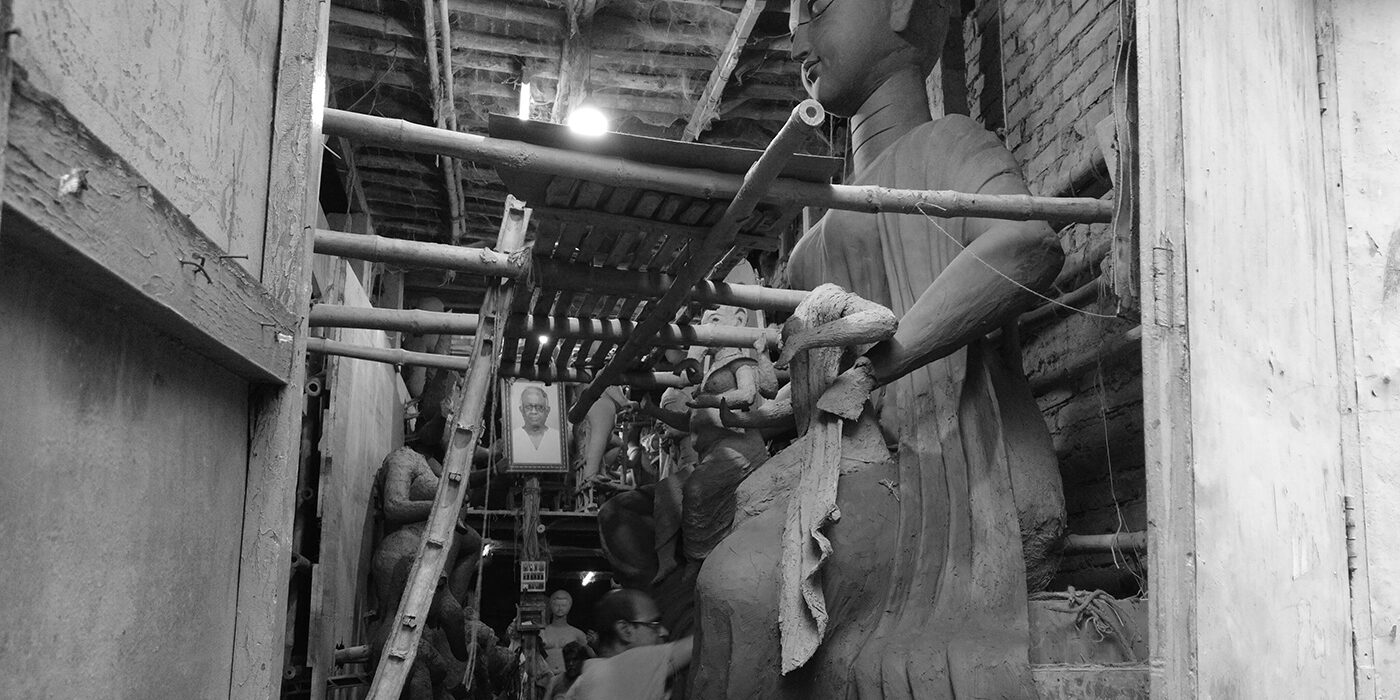
Image Courtesy : Sayan Biswas (Please do not use without permission)