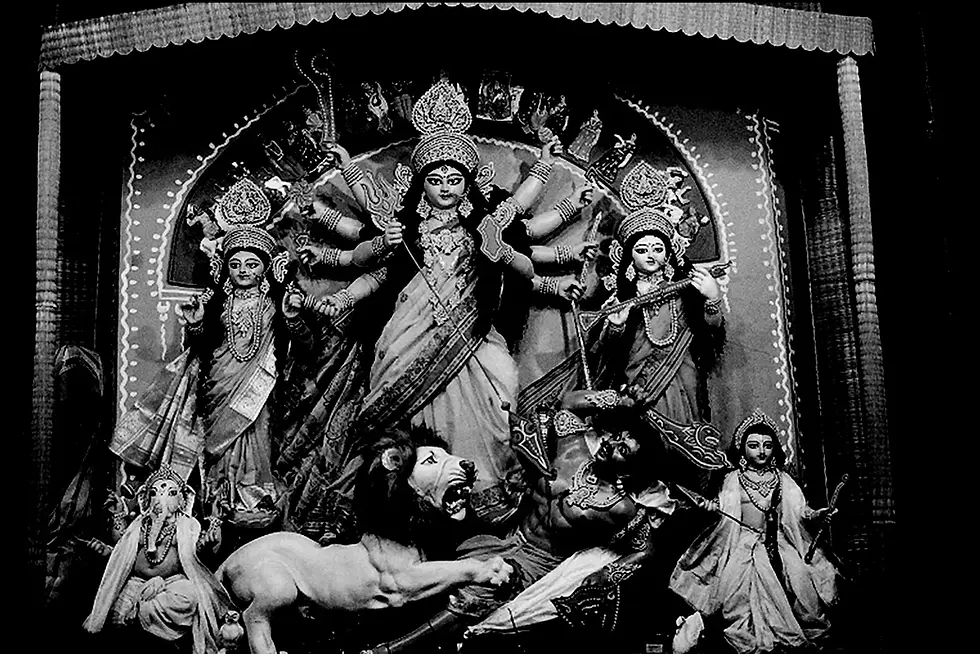
Bengal's Durga Puja: How an Ancient Festival Found Its Home in Kolkata's Courtyards

There's a particular shift in the air over Kolkata when the Ashwin sky fills with those loose white clouds and the kaash phul starts swaying along the riverbanks — the whole city seems to change how it breathes. But the festival that has become almost inseparable from Kolkata's identity today has roots that run much deeper than any single autumn: into old scripture, and just as much into the city's own tangled history. It's worth going back and tracing how a story about a mythological war slowly turned into the beating heart of an entire city's year.
The Markandeya Purana and the Birth of the Goddess
To find where Durga Puja actually begins, you have to go back to the Markandeya Purana, and specifically to a section within it known as the Devi Mahatmya, or Chandi. Composed somewhere between the fourth and sixth centuries, this is the text that first lays out, in real detail, the story of the Goddess's arrival as Mahishasuramardini — slayer of the buffalo demon. Mahishasura had performed penance and won a boon that made him unkillable by any man or god. The gods, after repeated defeats, eventually noticed the loophole in his own boon: nobody had ever mentioned a woman. So Brahma, Vishnu, Shiva, and the rest of the gods combined their own individual energy, their tejas, and Durga was born directly out of that pooled, frustrated power. Each god then handed her his own weapon — Shiva's trident, Vishnu's discus, Indra's thunderbolt — which is the real reason she's shown with so many arms. It isn't artistic flourish; every arm is carrying the story of a god who couldn't finish the job alone.
Interestingly, the timing of Bengal's Durga Puja doesn't actually match the Goddess's "correct" season according to scripture. Her proper worship, by tradition, belongs to spring — a festival known as Basanti Puja. According to the Ramayana, it was Rama who woke her early, in autumn, just before his battle with Ravana, in an act known as Akal Bodhon, the "untimely awakening." That exception is the very thing that became the rule. What we now think of as the traditional Durga Puja season is, mythologically speaking, a workaround that stuck.

Kolkata's First Durga Puja: A Blurry Page of History
Exactly when Kolkata's first Durga Puja took place is something historians still disagree on, and honestly, that uncertainty makes the story more interesting rather than less. Some trace large-scale Bengali Durga Puja back to the sixteenth century, to figures like Raja Kangsanarayan of Taherpur or the zamindar Bhabananda Majumdar of Nadia. But within Kolkata's own history, one name keeps resurfacing: the Sabarna Roy Choudhury family. They were the original landholding zamindars of the three villages that grew into the city — Kolkata, Sutanuti, and Gobindapur — and their pujas at Barisha and Andul are still counted among the city's oldest running family celebrations.
Another key chapter belongs to the Sovabazar Rajbari. After the British victory at the Battle of Plassey in 1757, Raja Nabakrishna Deb organised a grand Durga Puja partly to host and honour Robert Clive and his officers — some accounts suggest the event was as much about cementing ties with the British as it was about devotion. It's a useful reminder that Durga Puja was never purely a religious observance from the start; power, politics, and social status were woven into it from very early on.
The idea of a truly public, community-organised puja came later. In 1790, in Guptipara in Hooghly district, twelve friends came together to fund and host what is generally regarded as the first "Barwari" puja — a puja belonging not to one family, but to an entire neighbourhood. That single idea eventually became the seed for Kolkata's sarbojanin (community) puja culture, the same culture that today produces the elaborate, globally admired theme pandals the city is known for.
Kumartuli: Where Clay Becomes a Goddess
On the northern edge of Kolkata, right along the Hooghly, sits a small neighbourhood called Kumartuli, from which thousands of Durga idols are shaped and shipped out every year, some travelling well beyond Bengal and even overseas. Kumartuli's own history runs close to three centuries. As Kolkata developed into a trading hub through the eighteenth century, different trades settled into their own distinct quarters — potters in Kumartuli, weavers in Tantipara, and so on. Potters who migrated from what's now Bangladesh gradually built their homes and workshops here, and it was their craftsmanship that turned Kumartuli into the city's sculpting heart.
One tradition among Kumartuli's artisans still surprises people the first time they hear it: the clay used to build the idol is meant to include soil gathered from directly outside a sex worker's home, from what's referred to as the nishiddho palli, the "forbidden quarter." The reasoning behind this varies depending on who you ask. One belief holds that a man leaves his virtue behind at that threshold, which paradoxically makes that particular soil the most spiritually pure available. Others frame it as a form of inclusion — giving a community that society usually pushes to its margins a literal, physical share in creating the Goddess. It's a striking contradiction: the same society that so often looks down on these women considers the idol incomplete without the earth from outside their doors, once a year.
Today's Kumartuli sits comfortably between old and new — the traditional ekchala style alongside fibreglass theme idols, and occasionally figures shaped around contemporary social or political themes. But the moment of chokkhu daan, the painting of the eyes, remains the most sacred step for these artisans. Until that moment, it's simply a clay structure. Once the eyes are painted in, the Goddess is considered to have opened them, and to have arrived.
Bonedi Bari Puja: Where History Meets Aristocracy
Kolkata's bonedi bari — the old aristocratic family houses — still offer a completely different kind of experience from the dazzling lights of sarbojanin pandals. Sovabazar Rajbari, Jorasanko Thakurbari, the Mitra family, the Deb family, the Laha family — these households still carry centuries-old rituals that have deliberately been kept unchanged across generations.
In these homes, the idol's styling, the metal vessels used in worship, and even specific dishes offered as bhog are often fixed by family tradition rather than choice. In one house the Goddess might retain her traditional coloring; in another, the older daaker saaj ornamentation is preserved; in yet another, the idol's structure itself carries a family-specific detail — Durga worshipped alone rather than with her full family, for instance, or a different mount in place of the lion. These small, deliberate differences are exactly what set one bonedi bari puja apart from another, and each difference carries its own family story underneath it.
During the colonial era, these household pujas also functioned as stages for social mixing and quiet displays of power. British officers and prominent local figures were routinely invited; dance performances, music, even European instrumental recitals were part of the celebrations. Dhunuchi naach, the cannon-fired announcement of Sandhi Puja, special dishes for Navami bhog — some of these customs survive intact in a handful of houses today, even as many families, due to shrinking finances or shrinking numbers of descendants, have quietly let go of the old scale of celebration. Even so, every Ashwin, these doors open again, and for a few days, the old thakurdalans come back to life.
A Few More Lesser-Known Pieces of Mythology
Beyond the central story, Durga Puja carries a number of smaller, less-discussed but genuinely fascinating details. The bundle placed beside the idol, often mistaken by visitors for Ganesh's wife and nicknamed Kolabou, is actually the Nabapatrika — nine different plants tied together, representing the Goddess's older identity as agricultural and fertility power. It's one of the oldest, most folk-rooted layers of the festival, later stitched into the grander Puranic narrative.
Sandhi Puja is another oddly precise ritual — it has to be performed within a strict 48-minute window, the last 24 minutes of Ashtami and the first 24 minutes of Navami, because scripture holds that this is the exact moment the Goddess transformed into Chamunda to kill the demons Chanda and Munda. And in Kumari Puja, a young girl is worshipped directly as a living embodiment of the Goddess — a practice that's a quiet reminder that divinity, in this tradition, isn't confined to clay. It can briefly inhabit an ordinary person too.
In Closing
Durga Puja was never really just one story. It's several stories, layered on top of each other over centuries. On one side, there's the cosmic battle described in the Markandeya Purana; on another, the very real, very human history of families like the Sabarna Roy Choudhurys or the Sovabazar Rajbari. On one side, the quiet, patient craftsmanship of Kumartuli's artisans; on another, the folk-and-Puranic blend visible in things like the Nabapatrika or Sandhi Puja. The next time you're walking through Kolkata's streets, pandal-hopping, one of these stories might come to mind — and the festival might feel just a little deeper for it.