
When the Gods Became Light: The Cosmic Presence of Durga
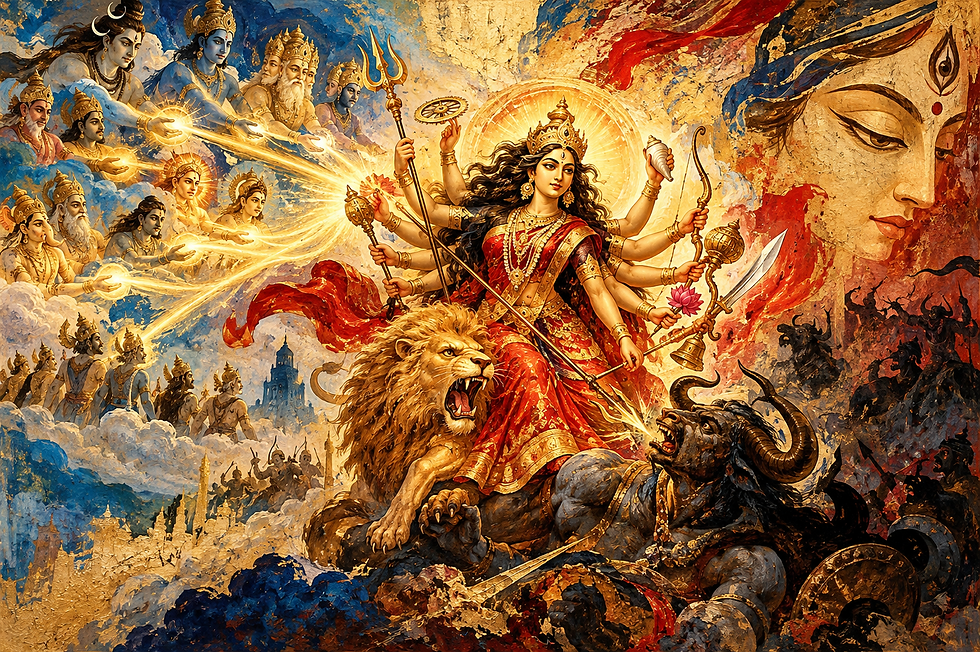
Before Durga appeared as the goddess of the battlefield, before the lion roared beneath her and the weapons of the gods gathered in her hands, there was only light.
Not the light of the sun, nor the flame of a sacred lamp, but something immeasurably greater—the collective radiance of the divine powers themselves. In the Devi-Mahatmya, preserved within the Markandeya Purana, the birth of Durga is imagined not as an ordinary birth, but as a cosmic event: the gods themselves becoming fragments of a greater Shakti.
The story begins at a moment when the gods had been overcome by the asura Mahishasura. Their celestial order had been shaken, their authority challenged, and the worlds threatened by a force that seemed almost impossible to defeat. In their anger, grief and desperation, the gods released their individual tejas—their divine brilliance.
Those rays did not disappear into the heavens.
They converged.
From Shiva, Vishnu, Brahma, Indra, Agni, Vayu, Varuna, Surya, Yama, Kubera, and the other deities, an immense field of radiance gathered until the heavens themselves seemed to burn with divine splendour. The separate powers of the gods became one presence.
And from that immeasurable brilliance, She emerged.
The Devi-Mahatmya describes her form as being fashioned from the very essence of the gods. Shiva's radiance shaped her face; Yama's became her flowing hair; Vishnu's brilliance formed her powerful arms. The moon gave its cool luminosity to her breasts, Indra contributed to her waist, while Varuna's energy shaped her thighs and legs. The Earth gave form to her hips, Brahma to her feet, and Surya illuminated her toes.
Her hands carried the energy of the Vasus. Kubera's brilliance formed her nose. Prajapati contributed to her teeth, while Agni became the fire of her three eyes. The twin Sandhyas—dawn and dusk—became her eyebrows, and Vayu gave her ears.
It is a remarkable mythology because Durga is not merely created by the gods.
She is the gods—made whole.
Every deity contributes something of himself, yet the resulting being is greater than the sum of those separate powers. The mythology transforms divine plurality into a single feminine sovereignty. Shiva's ascetic force, Vishnu's sustaining power, Brahma's creative intelligence, Agni's fire, Surya's brilliance, Vayu's movement and Varuna's cosmic depth all find their ultimate expression in her.
This is why Durga's body, in the Devi-Mahatmya, is more than an iconographical description. It is a map of the cosmos.
Her three eyes are not simply beautiful attributes. They evoke the three dimensions of time—past, present and future—and the three great cosmic forces of creation, preservation and dissolution. Her gaze therefore extends beyond the visible world.
Her many arms suggest something equally profound: the capacity to act in every direction, simultaneously. Durga is never represented as a passive divinity. She is dynamic Shakti—the power through which the universe moves, changes and renews itself.
Then came the gifts.
The gods, having contributed their radiance to her body, placed their most powerful weapons and sacred emblems into her hands. Shiva gave her the trident. Vishnu offered the discus. Varuna gave the conch. Agni placed a spear in her hand. Vayu gave her the bow and arrows. Indra offered the thunderbolt, while other gods presented the sword, mace, lotus, bell, noose and other divine instruments.
Each weapon carried the identity of its giver.
Yet in Durga's hands, they became something larger: a unified arsenal of cosmic order.
Her eighteen arms extended in every direction, holding not merely weapons but symbols of divine authority. She carried within herself the powers that the gods, individually, could not successfully wield against Mahishasura.
And then came her lion.
The lion beneath Durga is not merely a vehicle. In the visual language of Hindu mythology, it embodies courage, sovereignty and untamed strength. Yet the goddess does not struggle against the beast. She commands it. Power becomes disciplined power.
Upon this magnificent vehicle, radiant like the brilliance of countless suns, Durga enters the battlefield.
Opposite her stands Mahishasura—the buffalo demon, a figure whose shifting forms embody instability, arrogance and the refusal to remain within the order of creation. He is not simply an enemy with a sword. He represents a force that continually changes shape, making it difficult to defeat.
But Durga does not waver.
The battle described in the Devi-Mahatmya becomes a dramatic meeting between cosmic order and destructive arrogance. Mahishasura changes forms; the goddess remains sovereign. Gods watch as the power they could not individually command becomes unstoppable in her hands.
Finally, Durga defeats the buffalo demon.
The image that survives through centuries of Indian art captures that decisive moment: the goddess standing above the defeated asura, lion beside her, weapons surrounding her, her face composed even in the middle of cosmic violence.
There is something deeply distinctive about this serenity.
Durga is surrounded by destruction, yet she is not consumed by it.
Her face remains luminous.
Her posture remains assured.
Her power remains controlled.
That contrast is perhaps one of the deepest meanings of her iconography. The goddess does not represent violence for its own sake. She represents the restoration of balance when chaos exceeds its limits.
The Devi-Mahatmya therefore gives us more than the story of a goddess defeating a demon. It offers a vision of Shakti as the hidden unity behind the universe.
The gods possess power, but Durga reveals its indivisible source.
The moon gives her radiance, the sun gives her brilliance, fire gives her eyes, the earth gives her substance, the wind gives her movement, and the great gods give her their weapons. The entire universe appears to participate in her manifestation.
That is why the traditional image of Durga can feel larger than the figure itself.
She is not standing merely upon a battlefield.
She stands at the meeting point of heaven, earth and the unseen.
Her lion carries the force of nature. Her weapons carry the authority of the gods. Her three eyes look beyond ordinary time. Her many arms express limitless action. Her golden body reflects the primordial brilliance from which she arose.
And beneath her feet lies Mahishasura—the darkness that believed itself invincible.
Perhaps this is the enduring mystery of Durga in the Devi-Mahatmya: the gods did not create a new power to save the universe. They revealed the power that had always existed beyond them.
She was already there—in the fire, in the sun, in the wind, in the earth, in the moon, in the strength of the gods and in the hidden energy of creation itself.
They simply brought that scattered brilliance together.
And when all the lights became one, the Mother appeared.


