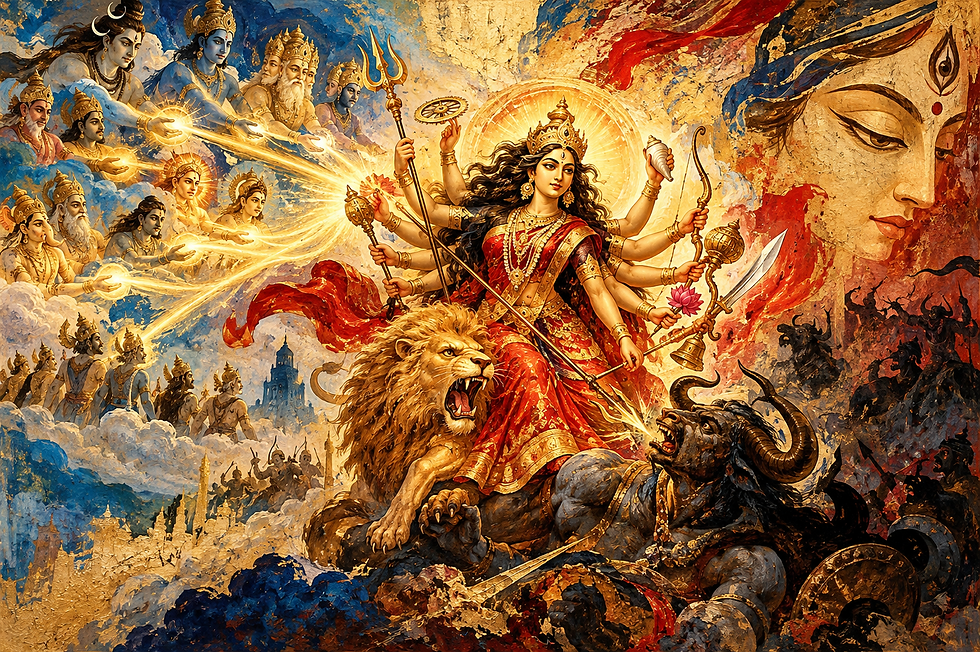
The Eternal Story of Mahishamardini Durga

Long before Durga became the familiar mother of autumn, before the sound of dhaak filled Bengal and before her image stood beneath the crimson sky of Sharad, she existed in another dimension of imagination — as Shakti itself, the force that rises when the balance of the universe begins to fail.
Among her countless manifestations, few are as powerful as Mahishamardini — the Goddess who destroyed Mahishasura, the buffalo demon. Her story is not simply one of a divine battle. It is a timeless metaphor for the struggle between order and chaos, consciousness and arrogance, and the forces that protect life against those that seek to overwhelm it.
The Goddess with Many Names
The Supreme Devi has never belonged to a single form.
Across India's sacred literature, she appears under different names, attributes and personalities, each revealing another dimension of the feminine divine. She is Durga, Chandika, Kali, Katyayani, Mahalakshmi, Mahakali, Kaushiki, Chamunda, Shakambari, Mahagauri and Mahamaya.
Yet beneath these names lies one presence.
The Devi Mahatmya, preserved within the Markandeya Purana, presents her as an extraordinary warrior goddess whose radiance emerges from the combined energies of the gods. When the forces of darkness become too powerful for the celestial beings themselves to overcome, their collective brilliance takes form as a woman of immeasurable power.
She is not created merely to fight.
She is Shakti made visible.
And when she enters the battlefield, even the gods recognise that the power before them exceeds their own.
Before the Warrior, the Mother
The antiquity of the Goddess is difficult to confine to a single century or scripture.
Some scholars have suggested that traditions of the Mother Goddess may reach back into India's pre-Vedic past. In early societies, where fertility, birth and the continuation of life were central to existence, the mother naturally became a profound religious symbol.
Archaeological discoveries from the Indus Valley have further encouraged scholars to explore the antiquity of feminine divine traditions. Sir John Marshall, who led major excavations at Indus Valley sites, proposed connections between ancient mother-goddess traditions and the later development of Shakti worship.
Whether every such connection can be established with certainty remains a matter of scholarly debate. Yet the larger continuity is striking: across vastly different periods of Indian civilisation, the feminine principle repeatedly returns as creator, protector, nourisher and destroyer.
The Mother changes her form.
Her power does not.
From Vedic Memory to the Great Goddess
References to fierce and protective feminine powers appear in ancient Sanskrit traditions, while later texts gradually develop a more elaborate theology of Devi.
The Upanishadic imagination deepened this idea by associating Shakti with the ultimate reality of Brahman — suggesting that the cosmic principle is not merely abstract, but possesses an active, dynamic power.
In this understanding, Shakti is the energy through which existence moves.
By the Gupta period, the worship of Devi had become increasingly prominent. Her presence spread through religious literature, sculpture and temple traditions. Later, with the rise of Tantric traditions, Durga and other manifestations of Shakti assumed an even more important position, accompanied by elaborate rituals, symbols and philosophical interpretations.
Thus, the Goddess was no longer simply a deity of mythology.
She became a cosmic principle.
The Battle with Mahishasura
Then comes the story that would define one of her most enduring identities.
Mahishasura, the buffalo demon, had acquired immense power and challenged the authority of the gods. Unable to defeat him, the gods released their individual energies. Their radiance converged, becoming a single dazzling presence.
From that extraordinary union emerged the Goddess.
Each deity contributed something to her manifestation — weapons, ornaments, strength and divine attributes. Armed with the trident of Shiva, the discus of Vishnu and weapons associated with other gods, she mounted her lion and entered the battlefield.
The conflict was immense.
Mahishasura repeatedly changed his form, moving between buffalo and other manifestations in an attempt to overpower her. But the Goddess remained unmoved.
Finally, when the demon emerged from the buffalo form, Durga struck him down with her trident.
The moment became immortal.
The buffalo demon fell. The Goddess stood victorious.
And from that victory came the name Mahishamardini — the Slayer of Mahishasura.
More Than a Battle
The Mahishasura story has endured for centuries because its meaning reaches beyond the battlefield.
Mahishasura can be read as the embodiment of unchecked force — arrogance without wisdom, power without restraint, desire without discipline.
Durga represents the opposite principle: strength guided by purpose.
She is fierce, yet maternal.
She carries weapons, yet she is the giver of nourishment.
She destroys, yet her destruction creates the possibility of renewal.
This paradox is central to the Indian understanding of Devi. The same divine presence can appear as the gentle mother, the radiant protector, the terrifying warrior and the ultimate cosmic power.
Durga in the Epics
The Goddess also enters the great epic imagination of India.
In the Mahabharata, Durga is invoked through hymns containing a remarkable collection of her names — Kumari, Kali, Kapali, Bhadra Kali, Katyayani, Durga and others.
She appears not merely as a benevolent deity but as a formidable power associated with victory, protection and warfare.
In one tradition, Yudhishthira invokes her as the destroyer of Mahishasura. The Goddess is envisioned with weapons in her hands, embodying the formidable character of the divine warrior.
The epic traditions also preserve memories of her worship among communities outside the dominant urban and courtly religious cultures, suggesting that reverence for the Goddess travelled across social and regional boundaries.
Her story belonged to many Indias.
The Goddess of a Thousand Names
Perhaps one of the most beautiful aspects of Durga's tradition is the sheer abundance of her identities.
She is Mahalakshmi, associated with abundance.
She is Mahasaraswati, associated with wisdom.
She is Mahakali, embodying time and transformation.
She is Katyayani, Vindhyavasini, Chamunda, Shakambari, Kaushiki, Chandika and Mahamaya.
Each name opens another doorway into the same mystery.
In some traditions, she is the radiant cosmic mother. In others, the terrifying destroyer of demons. Elsewhere, she is the nourishment of the earth or the wisdom that dispels ignorance.
The many names do not divide her.
They reveal her magnitude.
The Goddess in Stone
The story of Durga did not remain confined to manuscripts.
Across the Indian subcontinent, generations of sculptors transformed the myth into stone, metal and terracotta. Images of Mahishamardini appeared in temples and sacred spaces, particularly from the early centuries of the Common Era onward.
Her familiar iconography gradually became recognisable: the lion, the many arms, the weapons of the gods, and Mahishasura beneath her.
In Odisha, inscriptions and copper-plate records from approximately the 5th–6th centuries onward provide evidence of the continuing importance of mother-goddess traditions. Records from regions around ancient Tosali and present-day Puri further suggest the presence of established forms of देवी worship.
The archaeology tells a story of continuity.
The sculptures tell the same story in another language.
And the festivals continue to tell it in sound, colour and ritual.
The Promise of Durga
Perhaps this is why Durga has never truly disappeared.
Civilisations changed. Kingdoms rose and vanished. Languages evolved. Rituals acquired new forms. Yet the image of the Goddess returning whenever darkness grows too powerful remained remarkably constant.
The Devi Mahatmya gives this promise through the Goddess's declaration that whenever demonic forces rise and threaten the world, she will manifest again.
Her return is therefore not confined to one mythological age.
It is a promise renewed whenever humanity needs courage.
Every autumn, when the first fragrance of shiuli drifts through Bengal, when the dhaak begins to echo across neighbourhoods, when clay takes the shape of a mother with ten arms, the ancient story quietly begins again.
Mahishasura may belong to mythology.
But the battle the story represents is eternal.
And so is her arrival.
She is Durga — the Mother who protects, the Shakti that awakens, and Mahishamardini, whose victory reminds us that no darkness is beyond the reach of divine strength.