
Durga: The Mother Who Awakens the Power Within
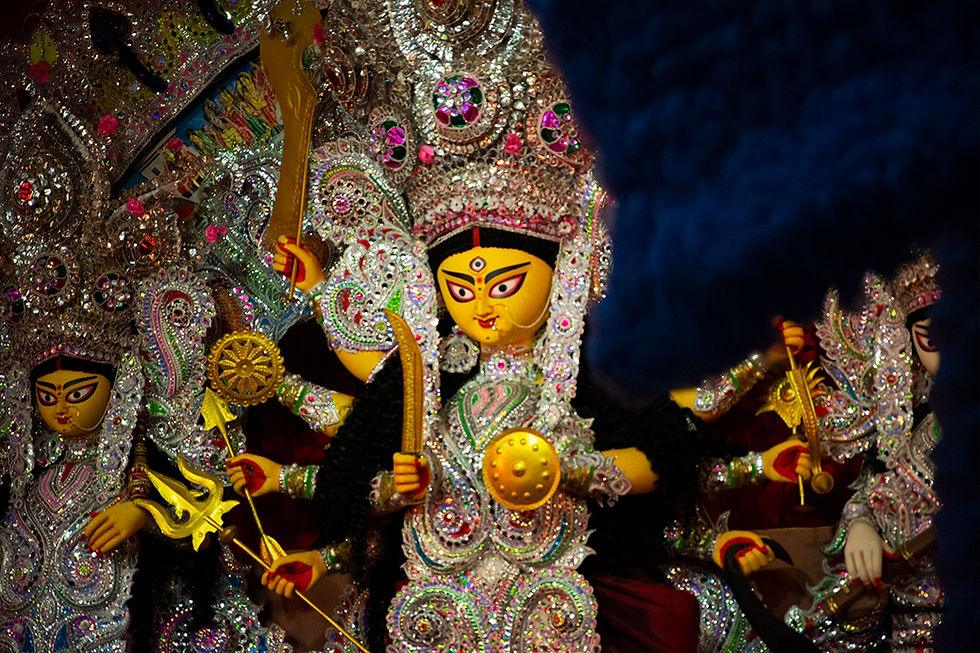
Every autumn, Bengal seems to change its rhythm. The streets grow brighter, homes become restless with anticipation, and somewhere beneath the sound of drums and conch shells lives an older story—the story of the Divine Mother returning to the human world.
Durga is often remembered as the warrior goddess who defeated Mahishasura. Yet the deeper meaning of her worship reaches far beyond a battle between a goddess and a demon. Durga represents Shakti—the living power of the universe, the force through which creation moves, life continues and transformation becomes possible.
This is why Durga is not simply worshipped as a distant deity. She is approached as Mother.
There is something profoundly intimate about that relationship. A child does not approach a mother with ceremony or distance. The child simply returns to her. Bengal has preserved this feeling beautifully. Durga is welcomed as a daughter returning to her mother's home, and when the Puja ends, she is bid farewell almost as a daughter leaving for her husband's home. The immersion is therefore not merely the end of a festival—it carries the tenderness of separation.
But there is another Durga hidden beneath the familiar image.
The ten weapons in her hands can be read not merely as instruments of warfare but as symbols of the tremendous forces required to overcome the darkness within. Her battle becomes our battle. The demon is no longer somewhere outside us; it becomes the ego, anger, greed, jealousy, selfishness, pride and other impulses that quietly govern human life.
This gives Navaratri an intensely personal meaning.
The nine nights are traditionally associated with the worship of the Divine Mother, but spiritually they can be understood as a journey inward. Before wisdom can illuminate a person, there must first be an honest confrontation with what clouds the mind. The first stage is therefore not about acquiring something new—it is about removing what should never have been there.
The ancient spiritual interpretation describes this as a movement from Jivahood to Shivahood—from the limited consciousness of the individual towards recognition of the eternal Self.
That journey demands strength.
And this is where Durga becomes deeply relevant. She is the power that enables a person to confront weakness without surrendering to it. She represents determination when the mind hesitates, courage when fear takes over and the strength to begin again after failure.
The Upanishadic tradition offers an equally fascinating dimension to the Divine Mother. In the Kena Upanishad, Uma appears as the one who reveals the truth to the gods, reminding them that their apparent power is not ultimately their own. Their victory is possible only through the Supreme Power behind them.
That idea quietly changes the way we see Shakti.
She is not merely a figure holding weapons, standing upon a lion. She is the power behind knowledge, action and existence itself. The source describes this power as manifesting through knowledge, strength and activity.
Perhaps that is why Durga Puja continues to feel larger than religion alone.
It brings together mythology, family, art, music, craftsmanship, memory and devotion. The sculptor shapes the goddess from clay. The painter gives expression to her face. The priest gives voice to ancient prayers. Families travel home. Communities gather. And for a few extraordinary days, an entire culture seems to remember something it already knows deep within—that strength is not always aggression, and divinity is not always distant.
Sometimes it arrives in the form of a mother.
The deeper message of Durga Puja, then, may be beautifully simple: the battle against darkness must eventually become an inner battle. The demon we seek to defeat is not always outside us. The real victory begins when we learn to conquer the impulses that diminish our own humanity.
That is why Vijaya—the victory—does not have to mean the destruction of another.
It can mean the victory of clarity over confusion, compassion over cruelty, humility over pride and courage over fear.
And perhaps this is the most enduring secret of the Mother.
She does not merely come to be worshipped. She comes to remind us of the strength that was already within us.


