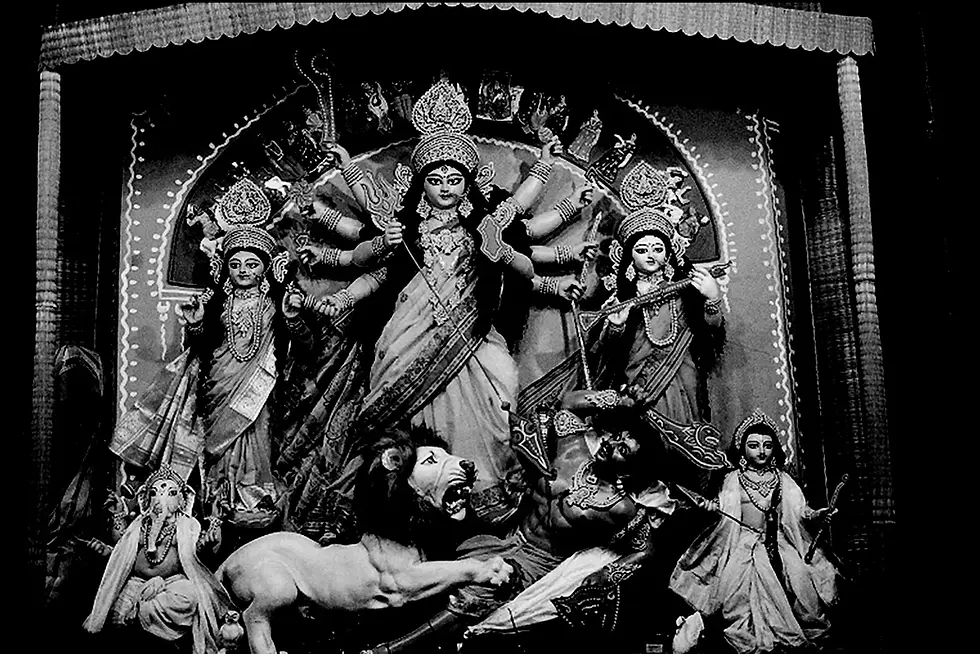
Waking the Goddess Out of Season: The Untold Mythology of Durga Puja

There's a strange little detail buried in the Durga Puja story that most people who grow up celebrating it never stop to notice: the festival is happening at the wrong time of year.
According to the older scriptural tradition, Durga's proper worship — her real season — was always spring. The autumn version that half of Bengal now builds its entire calendar around is, mythologically speaking, an improvisation. A workaround. And the story of how that workaround came to be is one of those pieces of mythology that rarely gets told at pandals, even though it explains almost everything strange about the festival's timing.
The Untimely Awakening
The story goes back to the Ramayana, to the days just before Rama's final battle with Ravana. Rama needed the Goddess's blessing to have any chance of winning, but there was a problem — the accepted time to invoke Durga was Basanti Puja, held in spring, months away. Rama couldn't wait that long. So, on the advice of Brahma, he woke the Goddess up early, out of season, in the middle of autumn.
This act has a name in Bengali tradition: Akal Bodhon, the "untimely awakening." It's considered slightly audacious even within the mythology itself — waking a goddess before her time, essentially asking her to show up to work on a day off. Some tellings add that Durga was displeased at being disturbed, and that Rama had to offer 108 blue lotuses to placate her, famously coming up one flower short and offering his own eye as the 108th, since his eyes were sometimes described as lotus-shaped. It's a small, strange, almost desperate gesture, and it's the reason Durga Puja lands in autumn at all. Every other version of the story is essentially building on top of this act of scheduling emergency.
A Goddess Assembled, Not Born
The more famous origin story — the one usually depicted in idols, with Durga astride a lion spearing a buffalo demon — comes from the Devi Mahatmya, a text embedded in the Markandeya Purana, likely composed somewhere between the 4th and 6th centuries CE. But the mechanics of how Durga came to exist are often skipped over, and they're genuinely strange when you slow down and read them closely.
Mahishasura, the buffalo demon, had a very specific type of invincibility. Through his penance, he'd secured a boon that no man or god could kill him. It's the classic loophole-boon structure you see across a lot of Puranic mythology, and the gods, having been humiliated and driven out of heaven by him, realized the flaw: nobody had accounted for a woman. So Brahma, Vishnu, and Shiva, joined by the other gods, each released their own concentrated energy — their tejas — and these combined into a single blinding mass of light that took the form of a woman. Durga wasn't born from a womb or created from clay; she was assembled, almost like a weapon, out of the frustration and pooled power of every major god who'd failed to solve the Mahishasura problem individually. Each god then handed over his own signature weapon — Shiva's trident, Vishnu's discus, Indra's thunderbolt — which is why Durga is depicted with so many arms. The arms aren't just for show; each one is doing a specific job with a borrowed tool.
The Vegetable Nobody Talks About
Anyone who has been to a Durga Puja pandal early on Saptami morning has probably seen a strange sight without realizing what it was: a bundle of nine different plants, tied together with a red-bordered sari, standing next to the main idol like an oddly dressed relative. This is the Nabapatrika — literally "nine leaves" — and it gets bathed, dressed, and worshipped as if it were a living member of the goddess's family.
Locally, it's nicknamed Kola Bou, which translates roughly to "banana-tree bride," and a lot of people casually assume, understandably, that she's Ganesh's wife, since the bundle is placed right beside him during the rituals. She isn't. The Nabapatrika represents Durga herself in a much older, more agrarian form — the nine plants (including a banana tree, turmeric, rice paddy, and a pomegranate branch) represent the presence of the goddess as embodied fertility and harvest, a layer of the festival that predates the warrior-goddess-versus-demon narrative entirely. It's one of the clearest surviving fingerprints of Durga Puja's roots in older vegetation and harvest worship, dressed up, quite literally, in a sari so it can stand next to the more Sanskritized mythology without looking out of place.
The Soil That Has to Come From Somewhere Uncomfortable
There's a rule in traditional idol-making that tends to make people uneasy the first time they hear it: the clay used to sculpt Durga's idol is supposed to include soil collected from the doorstep of a sex worker's home — referred to in Bengali as nishiddho palli, the "forbidden quarter."
The justifications offered for this vary depending on who's telling the story. One version holds that a man symbolically leaves behind his virtue at that threshold, meaning the soil there is, paradoxically, considered the most spiritually "pure" available, since all sin has already been deposited into it. Another interpretation frames it as an act of respect — recognizing that the goddess's power doesn't discriminate by social respectability, and that excluding this soil would mean excluding an entire class of women from participation in her creation. Whatever the reasoning, it's a rule that has persisted for generations of idol-makers in Kumartuli, and it sits at odds with almost everything else about how caste and social respectability usually operate in ritual spaces. It's rarely mentioned in the sanitized version of the festival's story, but it's one of the more genuinely radical details baked into the tradition.
A Living Girl as the Goddess
Durga Puja's mythology doesn't stay confined to painted clay. In several traditions, particularly associated with Ramakrishna and the Belur Math lineage, a young pre-pubescent girl is ritually worshipped as a living embodiment of the goddess — a practice called Kumari Puja. Her feet are washed, she's dressed in fine clothes, offered food first, and treated for the duration of the ritual as Durga herself, present in a human body rather than a sculpted one.
It's a practice that unsettles some people and moves others deeply, and it exists specifically to make a theological point: that divinity in this tradition isn't only locked inside consecrated clay figures brought to life through eye-painting ceremonies. It can occupy an ordinary child from an ordinary family for an afternoon, and then let her go back to being an ordinary child once the ritual ends.
The Exact Second Nobody Wants to Miss
If you've ever wondered why some Bengali families get almost anxious about timing during the festival, tracking the clock, it's because of Sandhi Puja — the worship conducted at the precise junction between Ashtami and Navami, the last twenty-four minutes of one lunar day bleeding into the first twenty-four minutes of the next.
Mythologically, this sliver of time is when Durga is believed to have transformed into her fiercest form, Chamunda, to destroy two particularly nasty demons, Chanda and Munda, in the middle of her larger war against Mahishasura's forces. Because the moment itself is considered so narrow and so potent, the ritual has to happen within that exact 48-minute window, no earlier and no later — traditionally marked with 108 lotuses and 108 lamps. It's one of the only widely practiced Hindu rituals where the precision of the timing is treated as more important than almost anything else about the ceremony.
A Demon Some People Still Mourn
Perhaps the most quietly controversial layer of Durga Puja's mythology involves Mahishasura himself. In the mainstream telling, he's simply a demon who needed to be destroyed, and his death is depicted as an unambiguous triumph of good over evil. But in parts of eastern India, and among several tribal communities including groups within the Asur community of Jharkhand, Mahishasura is remembered very differently — as a wronged local king, even an ancestor figure, deceived and killed rather than a villain justly punished. Some observe the same days as a period of mourning rather than celebration.
It's not a widely advertised counter-tradition, and it doesn't appear on pandal banners, but it's a reminder that myths this old rarely have just one version. The same festival that plays out across Kolkata as an unambiguous story of good defeating evil is, for a much smaller group of people not far away, a story about a defeated king who never got to tell his own side of it.