Durga: The Primordial Shakti and the Mother of the Universe

Long before the gods were given names, forms, and stories, Hindu thought speaks of a power that existed beyond form itself—a presence without beginning, without boundary, and beyond the reach of ordinary human understanding. This formless reality is often described as Nirguna Shakti: the supreme power before creation took shape.
In the Devi Bhagavata Purana, this primordial feminine principle becomes the centre of a vast theological vision. Here, the Goddess is not merely one deity among many. She is understood as Shakti itself—the power through which existence emerges, unfolds, is sustained, and ultimately returns to its source.
The Goddess is therefore both mystery and mother, cosmic force and compassionate protector.
Before Creation, There Was Shakti
The Devi Bhagavata Purana presents a universe in which the Divine Feminine occupies an extraordinary position. Its twelve skandhas and 318 chapters repeatedly return to the glory, nature, and power of Devi.
At the highest level, the Goddess is beyond attributes and appearance—Nirguna, without a limiting form. Yet the formless can become manifest. From this supreme Shakti arise the varied forces through which the universe operates.
These manifestations are traditionally associated with the three gunas—Sattva, Rajas, and Tamas.
Sattvik Shakti reflects clarity, knowledge, harmony, and the impulse toward creation and order.
Rajasi Shakti embodies movement, desire, activity, ambition, and the restless energy that drives manifestation.
Tamasi Shakti represents obscurity, dissolution, inertia, and the transformative force through which one form gives way to another.
These are not simply three separate goddesses or isolated powers. They can be understood as different expressions of the one cosmic energy—the same Shakti appearing through different qualities of nature.
Thus, Durga is imagined not merely as the Goddess who arrives when demons threaten the world, but as the deeper power behind the very rhythm of existence.
Jagatjanani — The Mother Behind the Cosmos
Among the many names associated with Durga are Shakti, Prakriti, Bhavani, Bhagwati, Maya, and Ashtangi. Each carries a different shade of meaning, yet together they reveal a remarkable theological idea: the Goddess is simultaneously the source, substance, and guardian of creation.
She is Jagatjanani—the Mother of the Universe.
The metaphor of motherhood is especially significant. The universe is not portrayed merely as something mechanically produced. It is nurtured. It grows. It is protected. It is corrected when it wanders from the path of dharma.
The Divine Mother can therefore appear gentle and infinitely compassionate, yet she can also become formidable when cosmic balance is threatened.
This duality lies at the heart of Durga's character.
She is the mother who embraces her children—and the warrior who rises when those children are endangered.
When the Gods Turn to the Goddess
One of the most striking ideas within Devi traditions is the reversal of an assumption familiar in many religious narratives: the masculine gods themselves may become dependent upon the power of the Goddess.
When confronted by forces beyond their ability to overcome, the gods turn toward Devi.
Her supremacy is not simply expressed through physical strength. It lies in knowledge, consciousness, power, and the mysterious energy that enables every other divine force to act.
In this understanding, Brahma, Vishnu, Shiva, and the other deities do not exist independently of Shakti. Their ability to create, preserve, or transform is inseparable from the cosmic energy that animates them.
The Goddess therefore becomes the answer when divine power itself encounters an obstacle.
This is one of the most profound dimensions of Shakta philosophy: Shakti is not merely the companion of the Divine—it is the power by which the Divine becomes active.
Durga, the Unconquerable
The very name Durga evokes the idea of one who protects against difficulty, danger, and forces that are difficult to overcome.
Her mythology repeatedly places her against destructive or demonic forces. Yet these battles are more than stories of celestial warfare. They represent the eternal struggle between dharma and adharma, wisdom and delusion, order and chaos.
The demon is therefore not always merely an external enemy. In symbolic readings, the forces defeated by Devi can also represent arrogance, ignorance, greed, violence, attachment, and the darkness within consciousness.
Durga's victory becomes a reminder that destructive forces, however overwhelming they appear, are not ultimately beyond the reach of divine order.
She protects not through passive benevolence, but through awakened power.
The Eight-Armed Goddess
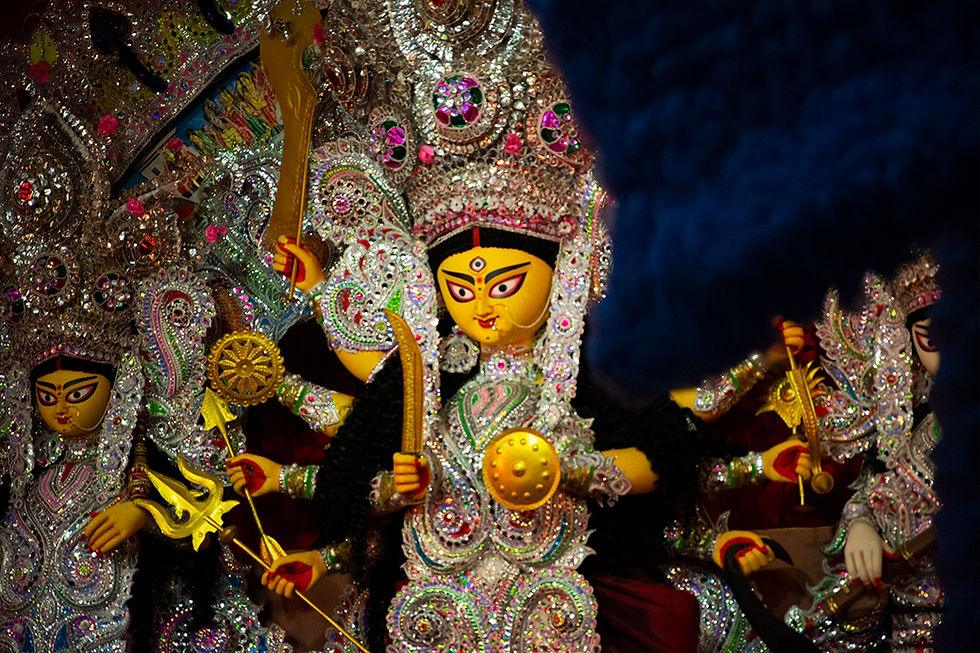
Durga is frequently represented as Ashtangi, the eight-armed Goddess. Each hand may carry a different divine weapon or sacred object, creating an image of extraordinary symbolic richness.
The weapons associated with her are not merely instruments of destruction. They can be read as emblems of different forms of spiritual strength—discipline, courage, knowledge, discernment, protection, and the ability to destroy what obstructs truth.
Her many arms also suggest something profoundly human: the Mother of the universe must be capable of responding to countless forms of suffering at once.
Where one hand protects, another destroys.
Where one hand grants blessings, another holds the weapon of justice.
The apparent contradictions coexist within the same divine figure.
The Womb of the Universe
Perhaps the most evocative way of understanding the Goddess is as the cosmic womb from which existence emerges.
Creation, in this vision, is not separate from the Mother. Everything that lives belongs to her cosmic order. She gives existence, sustains it, and ultimately receives it back.
This makes Durga both the beginning and the end—the eternal source from which manifestation arises and the ultimate reality into which all forms return.
Such a vision transforms the idea of the Goddess from that of a distant celestial figure into something much more intimate.
She is creator, protector, destroyer, mother, knowledge, nature, power, and mystery.
Beyond the Gods, Beyond Form
The deepest theological idea surrounding Devi is perhaps the simplest: the Goddess cannot be confined to the image through which she is worshipped.
The magnificent form of Durga—with her weapons, lion, crown, and multiple arms—is a visible expression of something considered ultimately formless.
The image gives the human mind something it can approach.
The philosophy points beyond the image.
Thus, the Nirguna Goddess can become Saguna—the Divine with attributes and form—without ceasing to be the infinite reality beyond all attributes.
This movement from the formless to the formed is central to understanding why Hindu traditions can simultaneously worship an intensely personal Mother and speak of an ultimate reality beyond every name and appearance.
The Eternal Mother
Durga's enduring appeal lies in this extraordinary union of opposites.
She is fierce, yet compassionate.
She is the destroyer of evil, yet the nurturing mother.
She is beyond form, yet celebrated through countless forms.
She is cosmic and intimate at the same time.
For devotees, Durga is not simply the Goddess who once descended to defeat demons in an ancient mythic age. She represents the enduring possibility that divine strength can arise whenever darkness threatens the balance of life.
The stories of Devi ultimately lead toward a larger idea: creation itself is animated by Shakti.
Everything that moves, grows, transforms, struggles, and renews carries something of that primordial energy.
And when the universe falls into disorder, the Mother does not remain distant.
She rises.
That is perhaps the enduring secret of Durga—the supreme Shakti who is both the silence before creation and the force that moves through every living thing; the Mother from whom the universe emerges, within whom it is sustained, and to whom, at the end of all things, it returns.