When the Goddess Rises Within: The Secret Journey of Navaratri

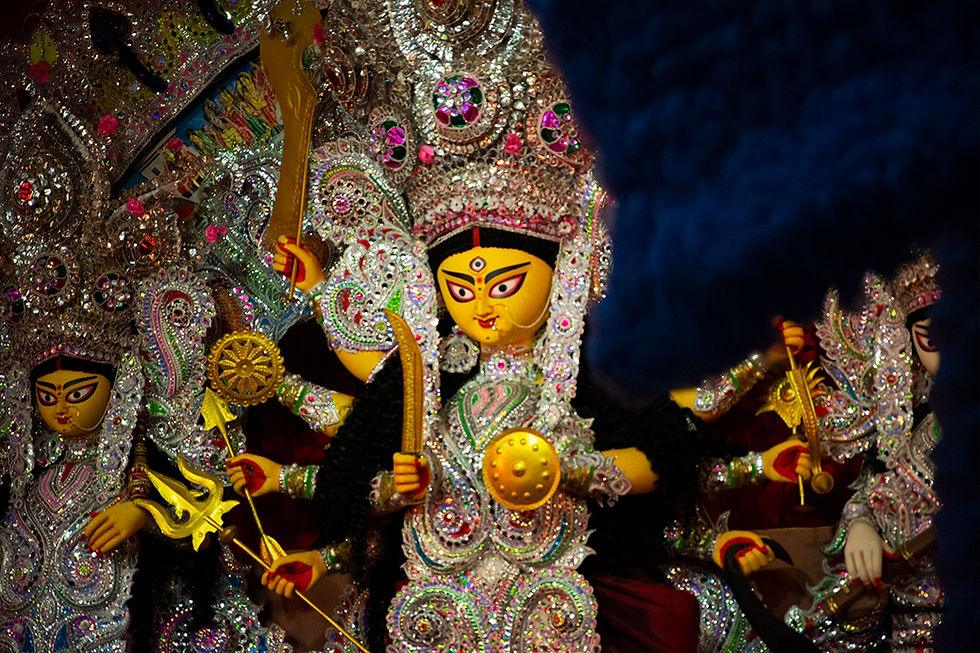
Every autumn, as the air becomes lighter and the nights acquire a quiet radiance, India turns toward the Divine Mother. Bells begin to ring, lamps are lit, sacred verses fill the air, and Durga arrives in a thousand forms—majestic, compassionate, fierce and infinitely still.
Yet Navaratri is not simply a celebration of a goddess who once defeated demons.
It is a story about us.
Behind the rituals, mythology and magnificent imagery lies an ancient spiritual idea: the battle between light and darkness is not fought only in the heavens or in the pages of scripture. It is fought quietly within the human heart.
The sages called the power behind this cosmic drama Shakti—the living energy of the Divine. She is not confined to one image, one name or even one religious imagination. Shakti is the power through which knowledge becomes possible, strength becomes action and creation continues its eternal rhythm. The ancient Devi Sukta of the Rig Veda speaks of this universal presence, while the Kena Upanishad reveals the Divine Mother as the wisdom that even the gods must learn to recognise.
Perhaps that is why the Mother has always felt closer than an abstract idea of God.
A child instinctively reaches for the mother because the mother is where tenderness and protection become tangible. In the spiritual journey too, the Divine Mother becomes an intimate presence—the power to whom one can surrender without disguise, carrying both weakness and hope.
But the Mother does not merely comfort.
She transforms.
The First Three Nights — The Courage to Face Ourselves
The opening movement of Navaratri belongs to Durga.
She appears as the formidable Mother, the one who enters the battlefield without hesitation. Her demons, however, can be read as something much closer than mythological adversaries. They are the tendencies that quietly govern our own lives—anger, arrogance, greed, selfishness, fear and the countless disguises of the ego.
This is why the first stage of the journey is destruction.
Before the mind can become luminous, something within it must be cleared.
Durga represents that uncompromising strength—the courage to confront what we would rather conceal. She does not simply protect the seeker from darkness; she gives the seeker the strength to enter it and overcome it.
There is nothing gentle about genuine transformation.
Old habits resist.
The ego negotiates.
The mind invents excuses.
And yet the Mother stands there, reminding us that spiritual growth sometimes begins with the difficult art of letting something within us die.
The Next Three Nights — The Wealth That Cannot Be Counted
Once the weeds have been pulled from the soil, the garden must be replanted.
This is the realm of Lakshmi.
Her meaning extends far beyond material abundance. The deeper wealth she represents is the wealth of character—purity, generosity, compassion, discipline, humility and those quiet virtues that make a human life luminous.
The spiritual path cannot end with the destruction of negativity. If anger disappears but compassion does not take its place, the transformation remains incomplete. If selfishness is removed but generosity is not cultivated, the empty space will eventually be occupied again.
Lakshmi therefore represents the beautiful work of rebuilding oneself.
The first three nights teach us how to let go.
The next three teach us what to grow.
The Final Three Nights — When Wisdom Finds a Quiet Mind
Then comes Saraswati.
She arrives not with the force of battle, but with the stillness of knowledge.
Her white form, her veena and her association with sacred learning have long symbolised the clarity that allows higher wisdom to emerge. But this wisdom is not merely the accumulation of information. It is the kind of knowledge that changes the way one sees existence—and eventually, oneself.
There is an order hidden in these nine nights.
First, purify.Then, cultivate.Finally, understand.
It is tempting to seek wisdom immediately. But the ancient vision suggests otherwise. A restless mind cannot hold stillness for long, just as an impure soil cannot easily nourish a delicate plant.
The journey begins with Durga, moves through Lakshmi and culminates in Saraswati.
Strength becomes virtue.
Virtue becomes clarity.
Clarity opens the door to wisdom.
And Then Comes Victory
On the tenth day comes Vijaya Dashami—the day of victory.
Tradition remembers many victories on this day: the triumph of the Divine Mother, the victory of Rama, the fall of Ravana. But the most intimate interpretation is perhaps the simplest.
Ravana's ten heads can be seen as the many faces of the ego—passion, pride, anger, greed, attachment, lust, hatred, jealousy, selfishness and crookedness.
Seen in this light, the burning of Ravana is no distant spectacle.
It is a mirror.
Every person carries something that must eventually be conquered—not another person, not another community, not an external enemy, but the restless force within that keeps saying I, me and mine.
That is the demon the festival ultimately asks us to confront.
The Goddess Is Not Somewhere Else
Perhaps the most beautiful secret of Shakti worship is that the Mother is never truly separate from the seeker.
The strength we pray for is already moving within us.
The wisdom we seek is waiting beneath the noise.
The compassion we admire is capable of becoming our own nature.
The ancient vision describes the Divine Power as immeasurable—appearing as knowledge, strength and activity, yet remaining beyond every name and definition.
So Navaratri can be understood as more than nine nights of worship.
It is nine nights of remembering.
Remembering that darkness must sometimes be confronted.
Remembering that life must be enriched with virtues.
Remembering that knowledge is more than learning.
And remembering, finally, that the greatest victory is the victory over the self that keeps us divided from our own deeper nature.
When Durga rises within, fear begins to lose its throne.
When Lakshmi rises within, the heart discovers a wealth no possession can measure.
When Saraswati rises within, the mind begins to see.
And when the tenth day arrives, the victory is no longer merely a story from another age.
It becomes personal.
The drums may fall silent. The lamps may eventually fade. The flowers may wither.
But if something within us has changed, even a little, the festival has fulfilled its purpose.
For the true Navaratri is not merely the nine nights when we worship the Goddess.
It is the nine nights through which the Goddess teaches us how to become more fully human—and, ultimately, more fully ourselves.