The Hidden Vision of the Devi Mahatmyam

Among the great sacred texts of Hinduism, the Markandeya Purana occupies a distinctive place. It does not simply preserve stories of gods, kings and cosmic battles; it carries a much deeper idea—the conviction that the visible world is moved by an invisible divine power. Within this vast Purana lies one of the most influential texts of the Shakta tradition: the Devi Mahatmyam, better known as the Durga Saptashati or Chandi Path.
For centuries, its verses have been recited in temples, homes and sacred gatherings, particularly during Navaratri. Yet the enduring power of the Devi Mahatmyam does not come only from its stories of demons being defeated by the Goddess. Beneath those dramatic battles lies an intensely human story: the struggle between fear and courage, confusion and wisdom, attachment and freedom.
The Devi Mahatmyam consists of thirteen chapters and seven hundred verses. It appears within the Markandeya Purana, traditionally associated with the sage Markandeya. Its narrative begins not with a battlefield, but with two broken men—a king who has lost his kingdom and a merchant abandoned by those he once trusted.
King Suratha has been defeated and driven from his throne. Samadhi, a wealthy merchant, has been betrayed by his own family. Although both have every reason to walk away from their former lives, their minds remain painfully attached to what they have lost. Why, they wonder, does the heart continue to cling to people, possessions and identities even after they have caused us suffering?
Their question leads them to the sage Medhas.
And his answer opens the door to one of Hinduism's most profound visions of the Divine Mother.
The Mother Behind the Veil
The sage explains that the same mysterious power that binds the human mind can also release it. That power is Devi—the Divine Feminine.
She is not presented merely as a goddess residing somewhere beyond the world. She is the force operating within it. She is memory and forgetfulness, hunger and satisfaction, sleep and awakening, knowledge and ignorance. She is present in the movement of life itself.
This is one of the most striking ideas of the Devi Mahatmyam: the Goddess is not simply one deity among many. She is the underlying Shakti through which the entire universe functions.
The gods themselves depend upon her power.
When the cosmic balance is threatened, their individual energies converge and take visible form as the Goddess. What appears as many divine powers is ultimately understood as one Shakti.
That vision gives the text its extraordinary philosophical depth. Durga is not merely the warrior who arrives to defeat a demon. She is the power by which the universe acts.
Three Battles, Three Inner Worlds
The great narrative unfolds through three principal episodes.
The first tells of Madhu and Kaitabha, forces that emerge from the primordial darkness and threaten the cosmic order. Their destruction is associated with Mahakali.
The second introduces the formidable Mahishasura, the buffalo demon whose changing forms make him almost impossible to defeat. Against him appears Mahalakshmi, the radiant warrior Goddess who gathers the powers of the gods.
The final battle is fought against Shumbha and Nishumbha, whose arrogance and possessiveness represent a subtler form of darkness. Here the Goddess manifests as Mahasaraswati and ultimately reveals that all the different forms of divine power are expressions of herself.
Read literally, these are magnificent mythological battles.
Read inwardly, they become something else.
They become the story of the human mind.
The demons can be understood as forces that live within us—ignorance, arrogance, attachment, desire, pride and the endless urge to possess. The battlefield is therefore not only a cosmic landscape. It can also be the interior landscape of consciousness.
Mahishasura is particularly powerful as a symbol because he refuses to remain one thing. He changes shape again and again. In much the same way, the ego rarely disappears simply because we recognize it. It changes its language, disguises itself as ambition, insecurity, pride, righteousness or even spiritual achievement.
The Goddess does not defeat him through brute force alone. She confronts him with a power greater than his constant transformations.
Why the Goddess Carries So Many Weapons
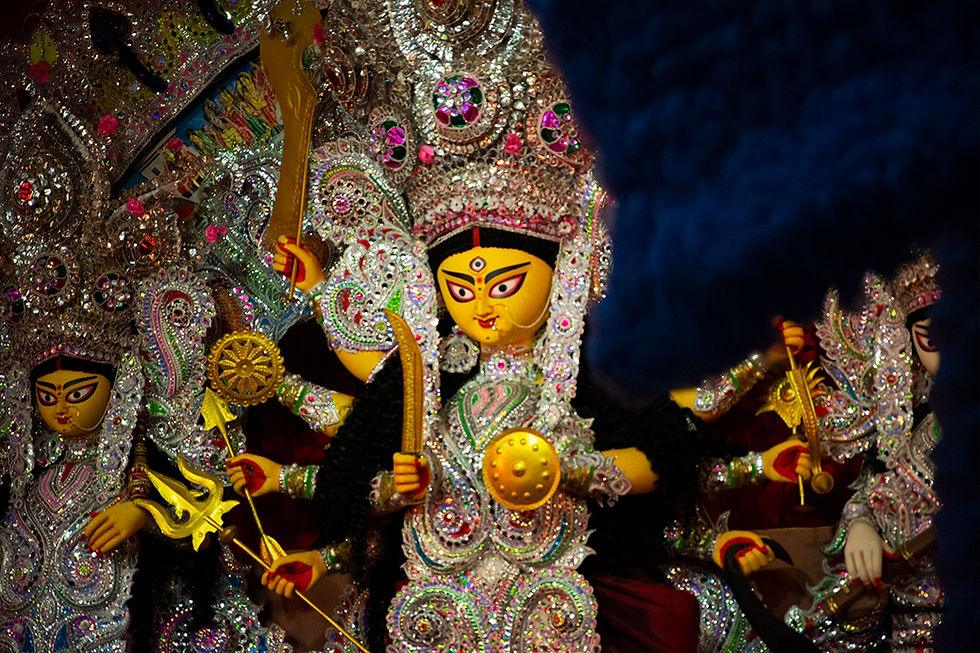
The familiar image of Durga surrounded by weapons has a deeper meaning than visual grandeur.
According to the narrative, the gods offer their individual weapons and powers to the Goddess. Shiva gives his trident, Vishnu his discus, Vayu his bow and arrows, Indra his thunderbolt, and other deities contribute their own divine instruments.
The symbolism is striking.
No single power is sufficient.
The Goddess becomes the meeting point of all of them.
Her weapons can therefore be understood as expressions of different forms of strength—discernment, discipline, courage, destruction of falsehood, protection and the ability to act at the right moment.
The image of Durga carrying many weapons is ultimately an image of integrated power.
She is not powerful because she possesses one extraordinary weapon. She is powerful because every necessary force has become united within her.
From Bhukti to Mukti
The Devi Mahatmyam is also remarkable because it does not separate worldly life from spiritual aspiration.
Its concluding passages speak of protection, prosperity, victory, freedom from fear, relief from suffering and the fulfilment of desires. But the text does not stop there. Its highest promise is liberation.
This gives the tradition two complementary ideas: bhukti and mukti—the experience of life and the freedom beyond bondage.
The Goddess may be approached for protection in difficult times, for strength when life becomes uncertain, or for prosperity and well-being. But the deeper teaching asks the seeker to go beyond the immediate wish and discover the power within consciousness itself.
In that sense, the Goddess is both the answer to the devotee's worldly cry and the destination of the spiritual journey.
“Ya Devi Sarvabhuteshu…”
Perhaps no idea expresses this vision more beautifully than the famous refrain:
Ya Devi Sarvabhuteshu...
“The Goddess who dwells in all beings…”
The verse repeatedly names the forms in which Devi exists—in consciousness, intelligence, sleep, hunger, shadow, compassion, faith, peace and many other aspects of existence.
The implication is profound.
If Devi lives in all beings, then the sacred is not confined to a temple image.
It exists in the mother, the child, the stranger, the animal, the river, the forest and the human mind.
The Goddess is both worshipped before us and encountered around us.
This is why the Devi Mahatmyam remains more than an ancient collection of stories. Its theology enters ordinary life.
A Scripture That Refuses to Become Distant
The remarkable survival of the Durga Saptashati is partly explained by its ability to live simultaneously in philosophy, ritual and popular culture.
It is recited during Navaratri. It forms an important part of Chandi worship and Chandi Homa. Its verses have travelled through generations of families, priests, scholars and devotees. Commentators have spent centuries examining its language, symbolism and tantric dimensions.
Its influence can also be seen far beyond scripture—in music, painting, sculpture, theatre, classical dance and the extraordinary visual culture surrounding Durga Puja.
Yet perhaps its greatest achievement is simpler.
It gives people a language for facing fear.
When life becomes uncertain, the devotee turns towards the Mother. When the mind becomes restless, the verses provide rhythm. When circumstances feel stronger than the individual, the story of the Goddess reminds the listener that darkness is never the whole story.
The demon may appear invincible.
But the Goddess has not yet arrived.
The Battle Is Still Being Fought
The ancient battlefield of the Devi Mahatmyam may seem impossibly distant from modern life. Yet its central conflicts remain strangely familiar.
We still struggle with attachment.
We still mistake possession for security.
We still allow pride to disguise itself as strength.
We still fight desires that return in different forms.
And we still search for something powerful enough to bring order to the chaos within.
That is perhaps why the Durga Saptashati continues to be recited after centuries.
Its real battlefield is not somewhere in a forgotten cosmic age.
It is here.
Within the human mind.
And its central message is not simply that Durga destroys demons.
It is that the power capable of destroying our deepest darkness is already present within the universe—and, therefore, within ourselves.
The Goddess is not merely the figure who stands at the end of the battle holding a weapon.
She is the courage to enter the battle.
She is the wisdom to recognise what must be defeated.
She is the strength to continue when defeat seems certain.
And, ultimately, she is the awakening that makes us realise that the battlefield, the warrior and the power behind the victory were never completely separate.
That is the enduring mystery of the Devi Mahatmyam—the Mother is both the one we seek and the power by which we are able to seek her.